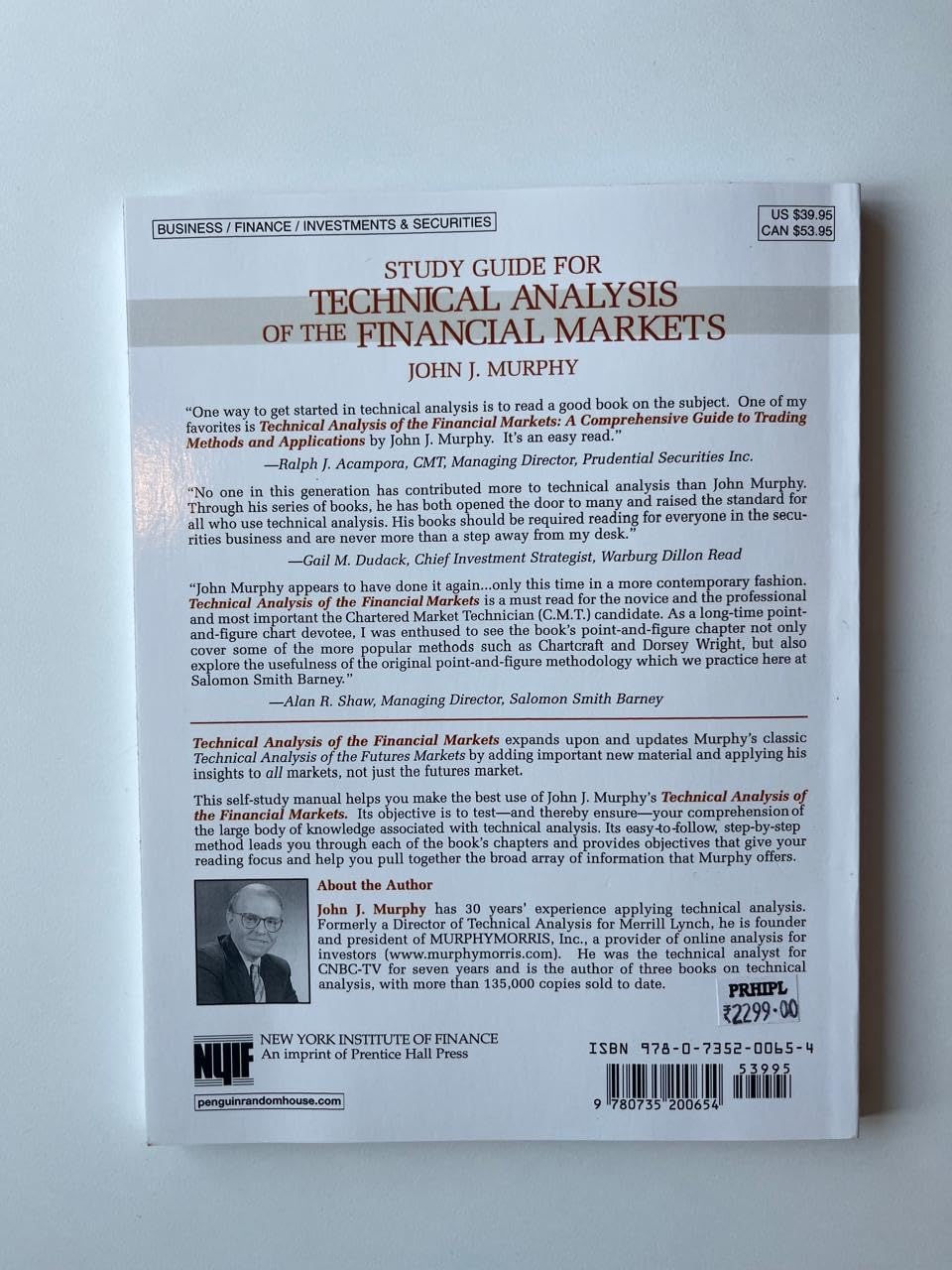
Navigating the complex world of financial markets can be daunting, especially for beginners and intermediate traders seeking to refine their strategies. The Study Guide to Technical Analysis of the Financial Markets: A Comprehensive Guide to Trading Methods and Applications (New York Institute of Finance S) offers an in-depth exploration of technical analysis—an essential tool for understanding price movements and market trends. This guide aims to empower readers by breaking down complex charting techniques and trading methodologies, making it an indispensable resource for anyone serious about market analysis.
Key Concepts
The Study Guide to Technical Analysis of the Financial Markets covers a broad array of topics critical for mastering market trends and executing informed trades. One of its standout features is the detailed coverage of candlestick charting, an essential technique used to visualize price movements and predict future market behavior. This method is particularly valuable for traders employing short-term strategies, providing clear visual cues about market sentiment.

Another significant aspect is the exploration of intermarket relationships, which highlights how different markets like stocks, bonds, commodities, and currencies interact and influence each other. Understanding these connections helps traders anticipate market moves with greater accuracy.
The guide also delves into stocks and stock rotations, offering insights on how capital flows between sectors and individual stocks, an important concept for portfolio management and sector-based trading.
Unlock the Secrets of Technical Analysis
Moreover, it provides updated examples and figures, reflecting the latest advancements in technology and technical tools that have transformed market analysis. This includes an overview of various technical indicators and their practical applications, crucial for traders to identify entry and exit points.
Throughout, there is a strong emphasis on the futures markets, making the guide especially relevant for those involved in commodities and derivative trading.
Pros & Cons
Pros:
- Comprehensive Coverage: Many users applaud the guide for its thoroughness, calling it the "Old and New Testament for technical analysts of financial markets." It caters to both novices and experienced traders by spanning fundamental and advanced concepts.
- Updated Content: The inclusion of new material on candlestick charts and intermarket dynamics keeps the guide relevant amid evolving market conditions and technologies.
- Accessible Explanation: Readers find the material approachable, allowing complex topics to be understood without a steep learning curve.
Cons:
- Mixed Value Perception: While many reviewers see the guide as a worthwhile investment, some consider it expensive relative to the information provided, describing it as a "waste of money." This may stem from expectations or familiarity with similar content elsewhere.
- Dense Material: A few users have noted that the depth and volume of content can be overwhelming for casual learners or those new to technical analysis.
- Primarily Focused on Futures Markets: Investors focused solely on equities or other asset classes may find some sections less applicable to their trading styles.
Who Is It For?
The Study Guide to Technical Analysis of the Financial Markets is ideal for traders, investors, and finance students who want a solid grounding in technical analysis with specific emphasis on futures markets. If you are committed to enhancing your chart reading skills, understanding intermarket effects, and adopting a systematic approach to trading, this guide serves as a valuable companion. It is particularly useful for individuals comfortable with detailed, textbook-style learning and those seeking to deepen their technical toolkit beyond basic strategies.
Explore Your Comprehensive Study Guide Now
Final Thoughts
In summary, the Study Guide to Technical Analysis of the Financial Markets offers a rich and detailed exploration of technical analysis concepts that are essential for navigating the futures and stock markets effectively. Its updated content on candlestick charting and intermarket relationships makes it a relevant read in today’s trading environment. While it may not be the quickest read or the cheapest option available, its comprehensive approach and practical insights make it a worthwhile resource for serious traders and financial analysts. For anyone looking to master market moves through disciplined technical study, this guide stands as a trusted foundational text.
As an Amazon Associate, I earn from qualifying purchases.